From Self-Asssessment to Self-Directed Success
How Dunning-Kruger, Self-Determination Theory, and Grit fit together and how to get from one end to the other By: Anjana Sengupta
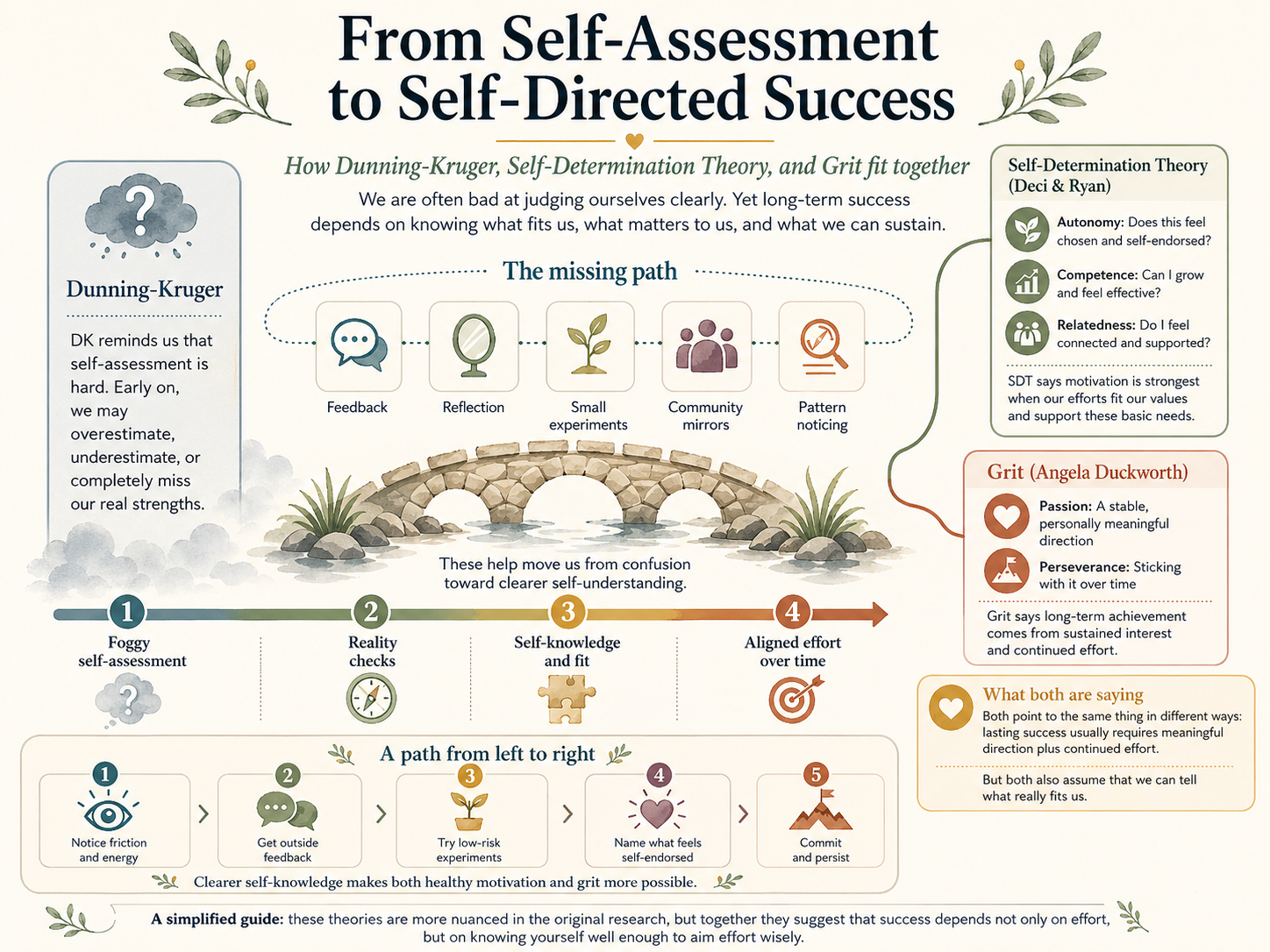
The Missing Path Between Self-Assessment and Self-Determination
One of the most difficult distinctions to make is between competence and self-endorsement.
A person can become highly capable in a domain without ever feeling that the work is truly chosen, meaningful, or personally satisfying for him or her. We build competence in an area that we are good at, but sometimes, it is not aligned with who we are.
We build competence for many reasons - survival, respect, income, independence, and especially social approval, or the simple need to move forward. But competence alone does not tell us whether a path is aligned with one’s values. In fact, it’s hard to know one’s values when one is very young, when one is choosing what to major in. Moreover, we’re not thinking about values when we are starting out, we are thinking about survival - i.e., money.
This distinction between competence and self-endorsement is easy to overlook because competence produces results and money.
It starts by producing grades in school and college, credentials after we graduate, promotions at work, income, praise, and social legitimacy. It gives us something measurable to recognize, admire, discuss, and congratulate. If a person is good at something, the external conclusion is simple: they should keep doing it.
The stronger the competence, the more pressure to keep doing it.
The internal story, however, can be — shall we say — different?
We perform well and still feel strangely detached from the work and the results. We are respected for a skill we don’t enjoy using. We build a life around a form of excellence that once served a purpose, but no longer feels real or true. Worst, we don’t know what else to do. We know that the problem isn’t a lack of ability.
We need self-assessment, all the coaches would say.
What is your passion, they ask? Surely, you must know by now?
We often speak as though people simply need to “know themselves,” “follow their passion,” or “find what it is that motivates them.” But knowing oneself is not straightforward at all. There are people in this world who simply ‘know’ their passion — but many do not.
It is not available through introspection.
If it were, more people would have already found their way there.
We don’t know who we are… in a vacuum. We only know ourselves through experience, through feedback and mirrors, reflection. Everything we like can be distorted by fear, necessity, praise, habit, family expectations, and society, not to mention the most important of all — economic pressure.
The Dunning-Kruger effect is useful to mention here, though perhaps not in its popular simplified form.
In popular culture, it is often described as the tendency of incompetent people to be overconfident. The deeper and more useful lesson is broader: human beings are NOT good judges of their own competence. Some people think they are brilliant and are objectively bad at what they do — and yet believe themselves to be excellent. Others are completely blind to their own strengths and are taken aback when someone points them out.
The point being… we do not see ourselves clearly. We may overestimate our abilities in areas where we lack skill, but we may also underestimate or completely discount abilities that come easily to us.
That second part matters. A strength can be invisible from the inside. If something feels natural, a person may assume it is obvious. If they can organize chaos, notice patterns, explain difficult ideas, listen deeply, or see the hidden structure beneath a messy situation, they may not recognize these as genuine strengths. They may think, “Doesn’t everyone do this?” The very ease of the ability makes it harder to value.
So self-assessment fails in both directions. We may fail to see our limitations clearly, but we may also fail to see our gifts. We may think we are better than we are in some domains and less distinctive than we are in others. We may cling to abilities that brought “success” while ignoring abilities that point toward being joyful and alive.
This matters because many theories of motivation and achievement assume a high degree of self-knowledge. The assumption is — you know your strengths and weaknesses. It’s an expectation.
Because from self-knowledge comes self-determination.
Self-Determination Theory (developed by Edward Deci and Richard Ryan) argues that human motivation is strongest and healthiest when three psychological needs are supported: [1] Autonomy [2] Competence, and [3] Relatedness.
But autonomy does not mean independence. In fact, it is not independence. It is much, much more.
Deci and Ryan’s paper on Self-Determination Theory is worth reading in full — the first couple of paragraphs alone are enough to delight. The central thesis is that one’s own actions must be self-endorsed, chosen, and aligned with one’s values. Autonomy means we choose what we want to work in.
This framework is important because it explains why external success is not always enough. Many people have competence without autonomy. They may be effective without feeling that the work is truly theirs. They may be praised by others while feeling disconnected from their own motivation.
Angela Duckworth’s work on grit points to a related issue. Grit is described as perseverance for long-term goals. The idea is so appealing: achievement requires more than talent. It requires true commitment, persistence, and the ability to stay with your chosen path through difficulty.
But perseverance is valuable only if the direction is worth sustaining. Persistence is great, but it can also become a trap if it keeps a person attached to a path that’s no longer right, meaningful, healthy, or self-endorsed.
Hard work and grit is an amplifier, not a compass.
If you’re facing the wrong direction, grit is only helping you get to the wrong place faster.
We encourage people to be self-determined. To choose, commit, and persist. Show grit. But before any of that can happen, there is a prior requirement - i.e., the critical task of self-assessment and to know one’s values. If we can know and judge ourselves — our strengths and weaknesses and blind spots — we will be able to choose work that is aligned with our values. To choose meaningfully, one MUST have the ability to distinguish between what is merely rewarded and what is truly valued. To say, “This is me,” one must be able to assess not only one’s competence, but also one’s energy, one’s values, interests, and personal alignment. But how does a person know what matters? Between genuine commitment and survival-based endurance? When to persist vs. quit?
Choice requires discernment. It requires the ability to notice what one actually values, what one is good at, what one dislikes despite being competent or excellent at it, and what kind of effort produces real, true growth rather than depletion.
This is especially difficult for people whose competence was built under constraint. If achievement was tied to survival, security, respect, or independence, then external success may have become the safest form of evidence. Feelings may have seemed unreliable, indulgent, and/or dangerous. The internal signals of the type — “I do not want this” or “I hate this” — may have been overridden repeatedly because the external rewards were too important to ignore.
We often treat self-determination as the starting point: choose your goals, persist with purpose. But for many people, self-determination is not the starting point. Self-understanding should be and this is why the path from self-assessment to self-determination cannot be reduced to a single moment of insight. One needs feedback, reflection, experiments, and pattern recognition. Feedback to correct mis-calibration. Reflection helps connect experience to meaning. Experiments allow us to test many directions without turning every question into a major decision. Pattern recognition helps us see the recurring signals: when energy rises, when resentment appears, when effort feels meaningful, when competence feels alive. We need a space where we can chronicle our true emotions about work. It’s critical to see patterns and signals over time.
In other words, before self-determination can begin, there must be a path from self-assessment to self-understanding. Not a quiz, not a framework on a whiteboard, not a coach asking what your passion is as if you had simply forgotten to look it up. A real process — one that gathers true evidence from the outside, holds up a mirror, and gives permission to take the signals seriously.
That process is what Thriven is built to be.
Thriven is available for early access → thriven.me