Every AI Can Generate. Not Every AI Can Be Trusted
We built Thriven around a deceptively simple idea: a language model without structure is just a very confident guesser. Here is the architecture we designed to change that.
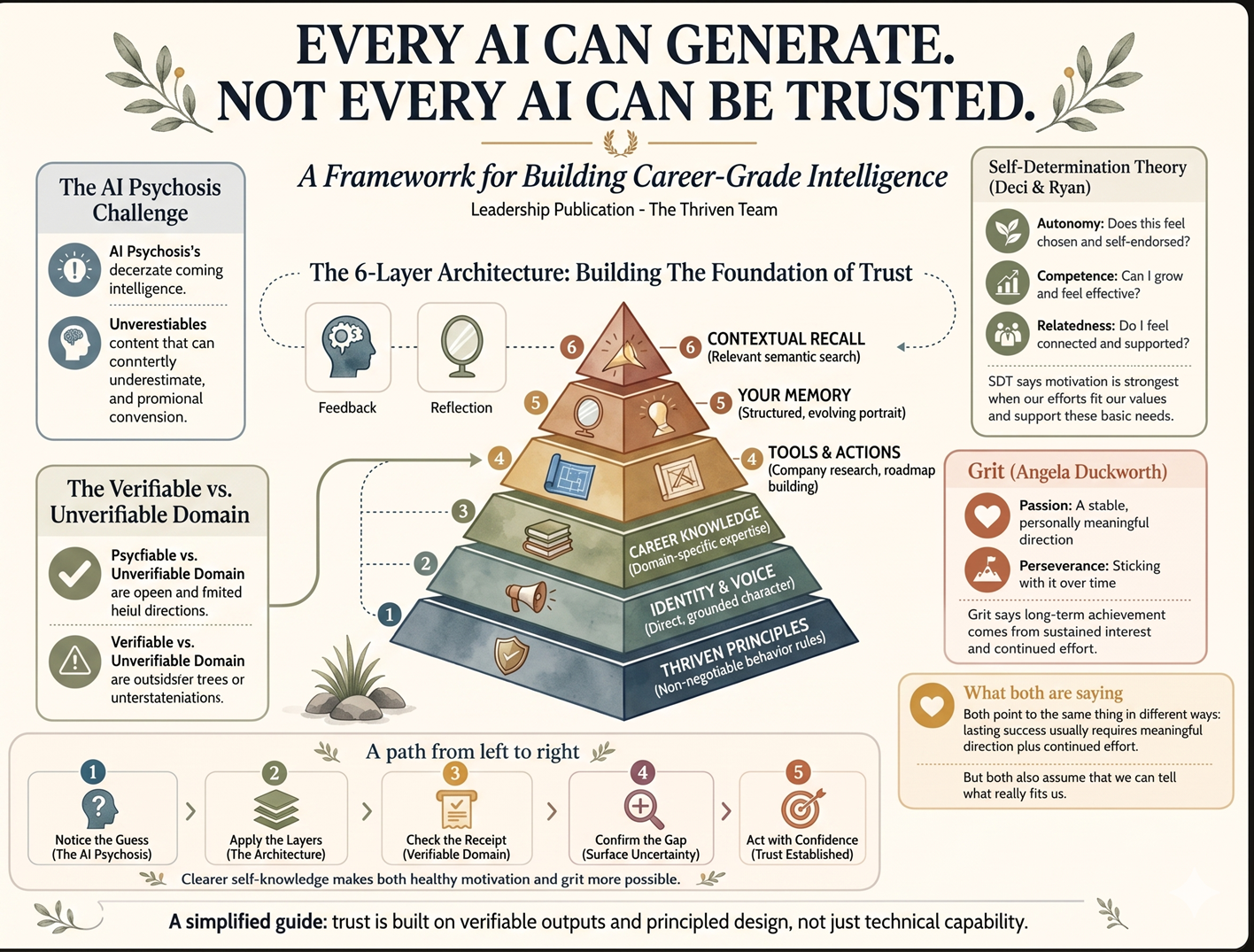
There is a seductive lie at the center of most AI career tools: that intelligence alone is enough. Give someone access to a powerful model, point it at their career questions, and watch the magic happen.
We spent a long time wrestling with why this does not actually work. The answer, when it came, was both obvious and unsettling.
Large language models are trained to predict the next most plausible word. Not the most true word. Not the most useful one for your specific situation. The most statistically likely one — the one that, across millions of training examples, tends to follow the words that came before it.
In a career context, this is quietly dangerous.
Ask an unconstrained model whether your resume is strong, and it will tell you it is. Ask it whether your plan to switch industries in six months is realistic, and it will validate it. Ask it what a hiring manager is thinking about, and it will tell you — confidently, fluently — something that sounds exactly right, whether or not it has any basis in your actual situation.
"A model that sounds right is more dangerous than one that admits it does not know."
We call this AI psychosis: a coherent, confident, well-phrased response with no anchor in reality. The model is not lying. It does not know how to lie. It is doing exactly what it was built to do — generating the next plausible token — without any structure that says: *stop, this is not grounded in what this person has actually told you.
Thriven was built specifically to solve this. And the solution is not a smarter model. It is a more deliberate architecture.
The Architecture
We think about Thriven not as a chatbot, but as a layered system. Each layer exists to constrain, enrich, or personalize the one above it. You cannot have the upper layers without the lower ones doing their job first. The foundation determines everything.
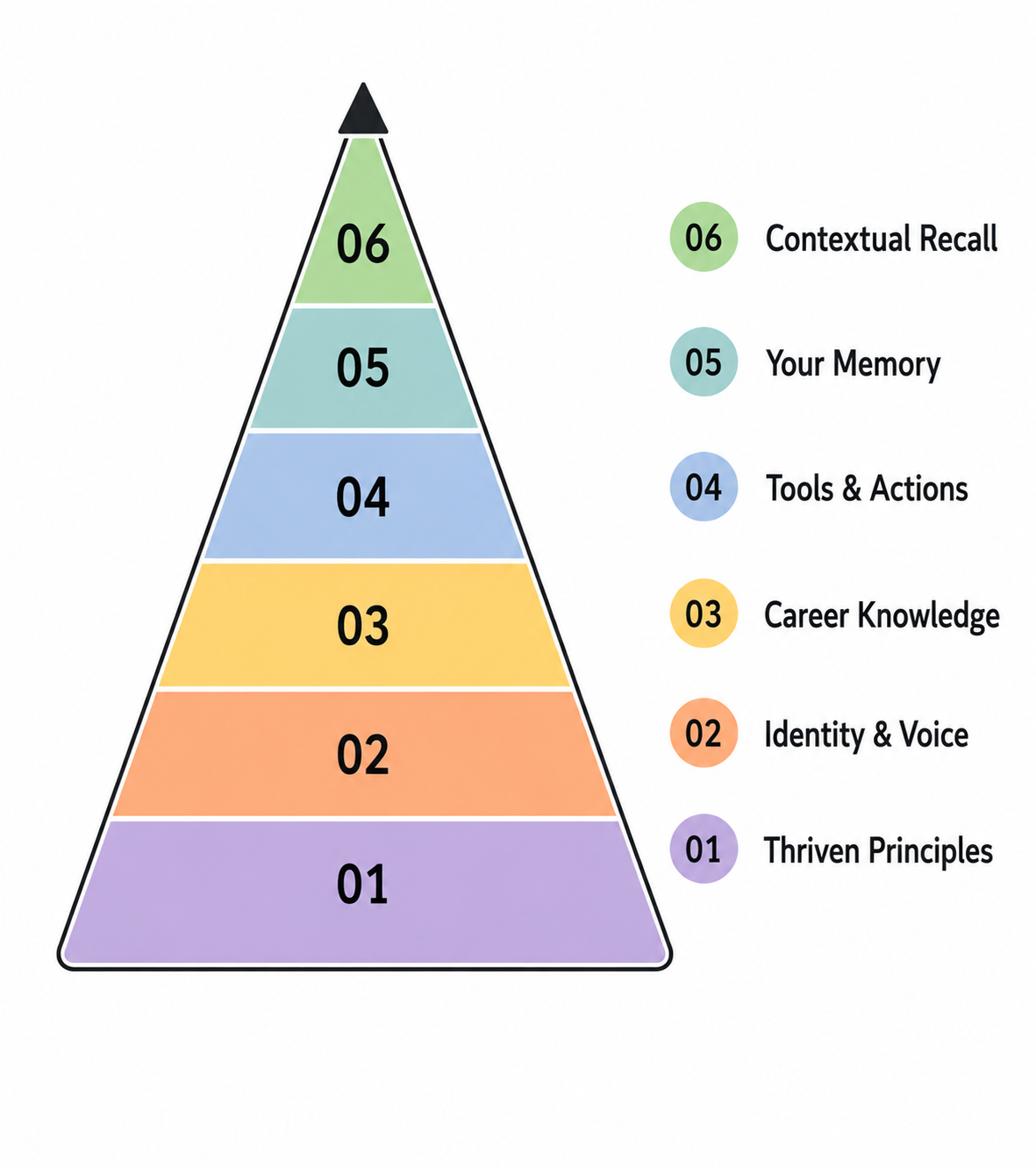
The Six Layers
Layer 01 — Thriven Principles
The Foundation
At the base of everything sits a set of non-negotiable behavioral principles — the hardcoded rules that govern every single conversation, regardless of how that conversation evolves. Thriven will not speculate beyond what it actually knows about you. It will not tell you what you want to hear at the expense of what you need to hear. It surfaces uncertainty rather than papers over it.
These are not suggestions. They are constraints that live below every other layer and cannot be bypassed by prompt, by context, or by the direction of a conversation.
Layer 02 — Identity & Voice
The Character
On top of principles sits Thriven's identity — the character, communication style, and perspective that shapes how it engages with you. This is not a persona bolted onto a generic assistant. It is a deliberate voice tuned specifically for career conversations: direct, grounded, and oriented toward your actual outcomes rather than your momentary satisfaction.
Without this layer, Thriven would be indistinguishable from any other AI with a career-shaped prompt pasted in front of it.
Layer 03 — Career Knowledge
The Expertise
Thriven is given structured knowledge about how careers actually work — how hiring decisions get made, how skills get valued in different markets, how industries shift, and what actually moves the needle in job searches, transitions, and negotiations. This is not abstract motivational content. It is domain expertise that is present in every conversation, giving Thriven a baseline that a general-purpose model would simply not have.
Layer 04 — Tools & Actions
The Capability
Intelligence without action is just commentary. This layer equips Thriven to go beyond conversation — researching companies and markets, building structured career roadmaps, tracking your network, identifying skill gaps, and logging real progress in your job search. These are not cosmetic features. They are the mechanisms through which insight becomes movement.
Layer 05 — Your Memory
The Persistent Self
This layer holds everything Thriven has come to know about you: your skills and how they have grown, the insights you have shared, the work that energizes you and the work that drains you, your career history, your current search, and the goals you are moving toward. It is not a raw transcript. It is a structured, evolving portrait — curated and ranked by how well-evidenced each piece is, how recently it surfaced, and how central it appears to be to who you are professionally.
Not everything you have ever said lives at the top of this layer. The things that have shown up consistently, been confirmed across multiple conversations, and proven most relevant to your trajectory earn their place in the working set. The rest is not discarded — it is held in reserve for the layer above.
Layer 06 — Contextual Recall
The Active Layer
This is where the real work of memory happens — and where most AI tools stop investing.
Holding a structured portrait of someone is one thing. Knowing which part of that portrait matters right now, in this specific conversation, is another problem entirely. Without solving it, memory becomes noise: a wall of facts the model must process in full on every message, regardless of relevance, driving up cost and diluting signal.
Before Thriven responds to anything you say, it runs a semantic search across your full memory — asking, in effect: what does this person know about themselves that is most relevant to exactly what they just said? It surfaces insights and skills you may not have thought to mention. It draws connections across conversations you had weeks apart. It brings forward the part of your story that is actually load-bearing for this moment.
The result is that Thriven does not just know you in general. It knows what matters right now — and that is a meaningfully different capability.
This mirrors how human memory actually works: some things you always carry with you; others you only recall when something brings them forward. Both matter. Thriven is designed to do both.
One thing worth highlighting here, is that Thriven also thinks between conversations and builds an understanding about you that changes and grows as you have more conversations together.
The Model Is the Engine. The Layers Are the Car
We believe large language models are genuinely extraordinary. The reasoning, synthesis, and communication capabilities of modern AI are unlike anything we have seen before. We did not build Thriven by doubting the model.
We built it by asking a different question: what does this model need around it to do its best work for your career?
"Power without structure is noise. We built the structure."
A model that knows only "answer career questions" will answer career questions. A model operating within Thriven's layers — anchored by principles, shaped by identity, informed by domain knowledge, equipped with real tools, and grounded in your specific context — does something far more powerful. It thinks with you, not just at you. It has a reason to be precise instead of merely plausible.
We do not fight the model. We give it the right environment to do its best work. That is the whole design philosophy.
Your Data. Yours
Your career data — your insights, skills, goals, conversation history, network, everything — lives on your device. We do not train on it. We do not sell it. We do not analyze it in aggregate. When you close the tab, your data is exactly where it was: in your browser, under your control.
Career data is among the most sensitive personal data there is. It carries your ambitions, your anxieties, your financial pressures, your professional regrets. We treat it accordingly. Storing it on your device is not a technical limitation — it was a deliberate design choice we made from the beginning and have not wavered from.
We only store data for the purpose of analyzing and improving user experience. Like, the total count of sessions, total message count, user turn count, total count of roadmaps, badges, XP points, level name, and last-active timestamp. None of your actual chat or profile data is stored in our database.
What We Mean by Guardrails
Guardrails sound like a limitation. We think of them as one of our most important features.
Thriven will not simulate what your future employer is thinking. It will not predict offer outcomes with false precision. It will not validate a plan it cannot actually assess. When it does not know something, it says so. When something you have told it does not quite add up, it asks rather than assumes.
The principles layer is active in every conversation. It does not require you to prompt it. It does not turn off when the conversation becomes emotional, or when you are deep into a frustrating job search and just want someone to tell you it will all work out. It is always there — ensuring that what Thriven tells you is grounded in what it actually knows about you, and honest about where that knowledge ends.
An AI tool that tells you comfortable things you want to hear is not a career tool. It is a comfort tool. Those are different products with very different responsibilities. We know which one we are building.
The Verifiable and the Unverifiable — And the Line Between Them
In most domains, AI gets to be fuzzy. General knowledge, creative tasks, code — the model synthesizes and responds, and if it is slightly wrong, the cost is low.
Career advice is not in that domain.
Career decisions operate across two fundamentally different territories, and confusing them is the source of most of the damage we saw in early AI career tools.
The verifiable domain includes things that either happened or did not: your skills, your work history, market data, job requirements, salary benchmarks, industry trends. These can be researched, confirmed, and referenced. When Thriven draws on them, it can show you exactly where they came from.
The unverifiable domain includes everything else: what a hiring manager is actually thinking, whether you will get the offer, how your old manager remembers you, what the right career path looks like for you ten years from now. These cannot be confirmed. They can only be speculated — and speculation dressed up as insight is where AI psychosis does its worst damage.
Thriven is designed to know the difference and to say so out loud. But knowing the difference is only half of it. The other half is showing its work.
"Most AI tools give you an answer. Thriven gives you the answer and the receipt."
When Thriven tells you that your background positions you well for a particular transition, it draws that from somewhere — from what you have told it about your history, from market research it ran, from patterns it has observed across your own career story. Those sources are not hidden inside a confident synthesis. They are surfaced as part of the response itself.
This matters because the alternative — a confident conclusion with no traceable origin — is exactly the kind of response that sounds authoritative but could be entirely untethered from your actual situation. The model does not know it fabricated a thread of reasoning. It was simply generating the next plausible token. The receipt is what forces grounding.
When Thriven cannot trace a conclusion back to something it actually knows about you or the market, it does not draw the conclusion. It asks instead. It surfaces the gap. It says: I do not have enough about this part of your situation to say that with confidence — can you tell me more?
That is not a limitation. That is the feature.
A Closing Thought
"The next generation of career tools won't be smarter chatbots. They'll be better-structured ones."
Anyone can put a career prompt in front of a language model. The question we kept returning to — the question that drove every design decision in Thriven — is what it actually means to be responsible for someone's career trajectory. What do you owe a person who is using an AI tool to make real decisions about their professional life?
The answer, we believe, is structure. Principles. Memory. Accountability. A system that is built to tell you the truth even when the truth is inconvenient, and that knows enough about you to know what truth is relevant.
That is what we are building. We are glad you are here for it.
Thriven is available for early access → thriven.me